Ride back from dinner on Sanibel without a bike light and you will discover something about the island within about two hundred yards. It is genuinely dark.
That is deliberate on two counts. The city's plan has kept street lighting to a minimum since the 1970s as part of keeping the island's character, and the beachfront lighting regime exists for the sea turtles that nest here.
The nesting season
Loggerheads are the main nesters on these beaches, with green turtles in smaller numbers. On Sanibel and Captiva the season starts around the middle of April — earlier than the statewide date visitors often quote — and runs to the end of October. Exact dates are set locally; confirm them for the year you are visiting.
During that window, marked and staked nests appear on the sand and lighting restrictions apply to anything visible from the beach.
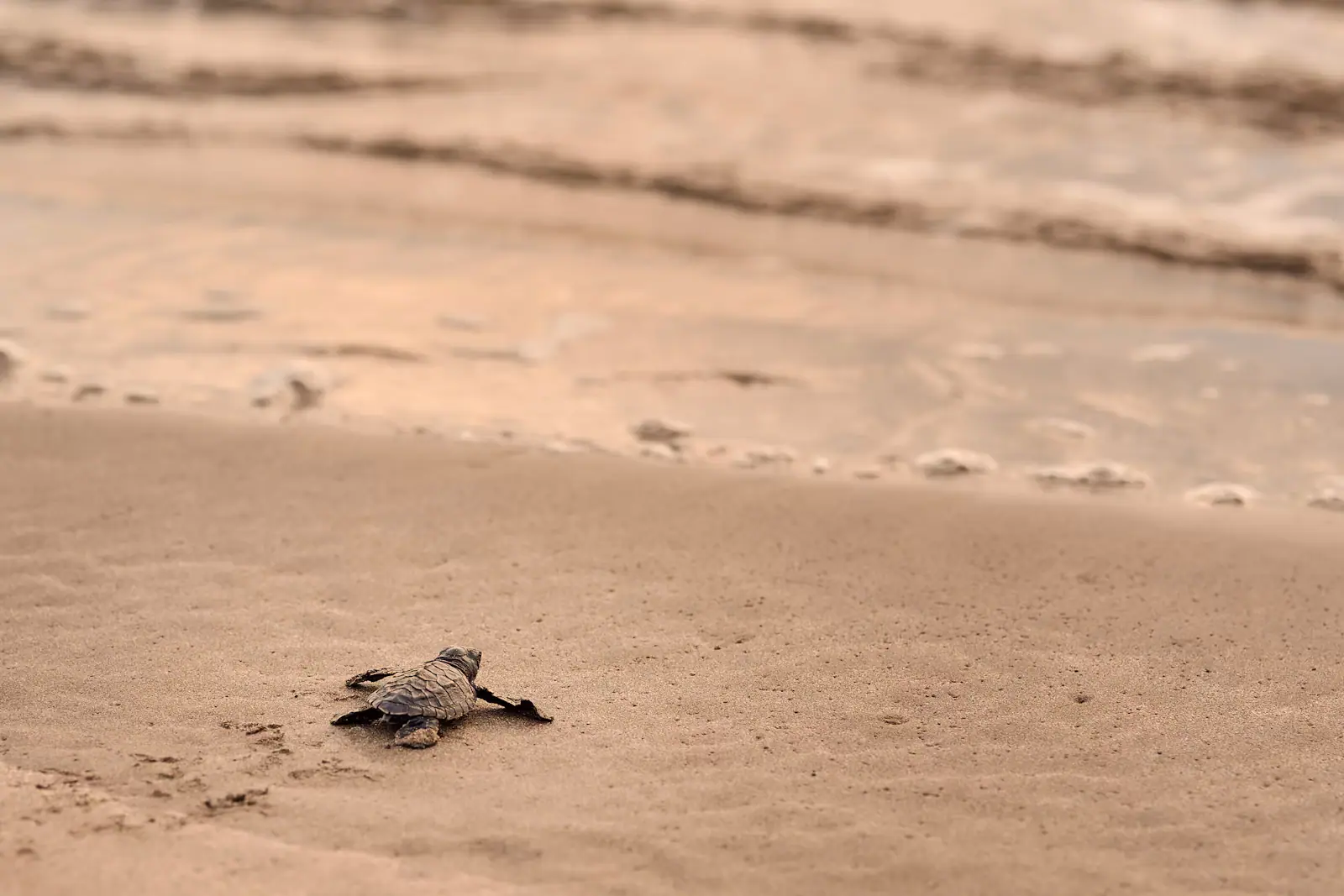
The mechanism is worth understanding, because it explains why the rules are as specific as they are. A female that runs into artificial light partway up the beach will frequently give up the crawl and go back into the water without laying at all. And a hatchling breaking out of the sand finds the sea by heading for the lightest part of the horizon, which on an undeveloped coast is the water reflecting the sky. Put a porch light behind the nest and the whole system inverts: the brood sets off inland, toward the road.
What it means for a visitor
- Balcony and patio lights stay off after dark for the whole season, and curtains get drawn in any room facing the water. This applies to a rented cottage exactly as it applies to a resort.
- Nothing lit on the sand after dark, and a phone screen counts. So does a camera flash.
- Level what you dug before you go, and knock the castle walls flat. A hatchling has a hundred feet of open beach to cross and no way back out of a pit once it drops in.
- Carry your own gear off at the end of the day. Chairs, shade tents and abandoned buckets all sit directly across a route that has to be navigated in the dark by an animal a couple of inches long.
- Staked nests stay exactly as you found them.
- Come across a nesting female or a brood heading the wrong way and the correct response is to stand back, stay quiet, kill the lights and call it in. Do not pick anything up.
And the practical consequence
Carry a torch for walking back to the car, and keep it aimed at your feet and off the sand. Lights on a bicycle are a legal requirement after dark and a genuine necessity on a path with no street lighting beside it.
The compensation is a night sky that most of coastal Florida no longer has.